An introduction to fascinating subjects,
people, and places.
You too may become a dilettante. It is not boring.


From Jacksonville Beach, FL

Thursday, March 19, 2015

Wear an over-the-top vintage wedding gown

  If you're planning a June wedding, it's almost time to send out the invitations, and no doubt you have long ago purchased your wedding gown.  In looking through my stash of vintage photographs, I found four brides/gowns that are truly beautiful.  All are from the early 1900's, but were not dated.
  The brides, if they are still living, are little old ladies now, but they were truly young and beautiful on their special day.  I can't imagine how their photographs got in the estate sales where I found them.  What family could part with them.  
   Some modern brides opt for a vintage gown, perhaps one that belonged to a grandmother or aunt. There is a small trend for vintage wedding gowns and weddings.  Web sites are available (see end of article).
   Brides wearing white can be traced back to the wedding of England's Queen Victoria in 1840. In America, Godey's Ladies Book, one of the first women's magazines, said that white was the fitting color for bridal gowns. Soon is was the only color except for the occasional rebel.


   This decorative gown might be from the 1920's.  It has an overskirt and train typical of many gowns from that decade.  

                                                                      
This lovely and extravagant gown possibly dates from the late 1800's to early 1900's.  The small waist, the high neck point in that direction. Also the bride's jewelry is a large cameo pin and she has a Gibson Girl hair style.


   The hair style of this bride indicates she is probably from from the 1930's.  
Her beautiful hat is the main feature. In the 1930's, many brides opted for a hat as a headpiece rather than the traditional veil.  It is also possible this woman is a bridesmaid
rather than the bride since her dress is sleeveless and somewhat simple.


This fitted gown is elaborately decorated, with a small amount of flair.  It is buttoned down the front with tiny buttons. The photograph was taken at a studio in San Francisco.

Fragrant orange blossoms from my Florida tree.
Queen Victoria wore orange blossoms on her
wedding gown.


See more vintage gowns:

http://www.bridalguide.com/planning/wedding-planning-basics/weddings-through-the-ages
http://all-that-is-interesting.com/history-of-wedding-gowns
https://www.pinterest.com/explore/modern-vintage-weddings/

Thursday, March 12, 2015

Bring back the watchdogs of society!!

 
      I've always been a news hound.  As a kid, I saw a lot of movies featuring newspaper reporters who bettered the police and solved the crime. They had sassy talk, smoked a lot and stayed up late.  It was my ambition to be a reporter. 

   In high school I joined the newspaper staff.  During my college sophomore year, I interviewed with the dean of the College of Journalism.  I told him I wanted to be a real writer not a society page reporter, which was the job most women journalist were give in those days.  His answer, "Who do you want to be Dorothy Killgallen?"  It was spoken like an insult.  How dare you want to enter the world of real journalism.  Killgallen was a rare woman then, a real journalist in a man's world.  

   As it turned out, I ran out of college money, applied for a teaching scholarship, and gave up my newspaper dreams for teaching.  I still followed my goal, however, by teaching English and journalism and sponsoring the school newspaper for many years. 

     Few students these days long to be reporters. Newspapers are dying.  For most of my life the newspaper was the heart of a city. Journalists were the watchdogs of society, searching out wrongs, exposing criminals and frauds.  Today, except for a few big city papers, the New York Times, Washington Post,  Los Angeles Times, Chicago Tribune, newspapers report mostly local news and stories people have already heard on television or the internet, which can get the news out almost the minute it happens.  

   Reporting local news, however, is a good thing.  By making the public aware of local elections, events, city problems, and providing some recognition for jobs well done, newspapers can help improve a city's sense of community. A journalists main job is to inform objectively. We need this service.  How then can we rescue the newspaper from possible oblivion?  

   The most important rescue comes from keeping your newspaper subscription.  I have so many friends who have stopped theirs.  Yet, they can't quite give it up. They borrow my paper or sections of it to get the crossword puzzle, the grocery store ad insert, the classified ads, or the stock market report.  A newspaper has to have sales to interest advertisers and have enough customers to make money.  Many papers have gone under because their revenue just wasn't enough.  

   I'm not yet ready to give up the newspaper.  I want them to continue until I'm a little, old lady so I can still read it with my morning coffee. Buy your own paper.  Renew your subscription.  You will do a good thing.

Wednesday, March 4, 2015

What's in a Sourthern Name?


Ellie Mae, George Washington Carver, J.R. Ewing, Billy Graham, Dixie Carter--What do these names have in common? Give yourself a point if you guess they're all Southern. Give yourself 10 points if you guess that each represents a characteristic of Southern naming. 

Double names

Thirty or forty years ago, script writers began giving Southern characters names such as Billy Bob and Ellie Mae. The Southern tendency toward double names became a caricature and a joke, but like all satire there was truth in it. Double names have been more pervasive in the South than any other region. Billy Bob might have been christened William Robert, but chances are he was not. Shortened versions of names and nicknames became the given name, and Billy Bob was called by both names all his life.

A look at my high school, senior class yearbook indicates that Ann, Mae, Sue and Jean were the most popular second names for girls of my generation. My classmates were Mary Ann, Jo Ann, Patsy Ann, Delia Ann, Lola Ann, Margaret Ann, Joyce Ann, Edna Mae, Ella Mae, Lyndal Sue, Betty Sue, Marcell Jean, Beverly Jean. There is no similar pattern for males of the same year. Their middle names range from Cade to Taylor.
Naming is sometimes done without respect for gender. Connie, Bobbie, Gene, Carroll are given to males and females. Sometimes two given names represent both sexes and are given to both boys and girls: Constance Robbie, Will Annie, Shelly Rae, Sandra Benn, Tommy Ruth. Usually, however, the first name is the same gender as its bearer, but not necessarily.

Most modern Southern parents are moving away from calling children two names, and after years of television jokes, many older Southerners have dropped one name. For example in my family, my Aunt Will Annie is now Anne; Aunt Sarah Nell became just plain Sarah; Rebecca June prefers Becki. Bobbie Mell (named for grandfathers Robert and Melvin) is now just Bobbie. People often misunderstood the name, calling her Bobbie Bell, which she hated even more than Mell.

Heroic names

Interestingly, the casualness of short forms of names is offset by grandiose, heroic names. Military heroes, Presidents, and Southern dignitaries' monikers have been given to many tiny Southern babies. Since the Civil War, Robert Lee and Jefferson Davis have been used countless times. Botanist George Washington Carver lived up to his famous name. Former Florida governor Napoleon Bonaparte Broward is another well-known example of heroic naming.

Surnames as first or middle names

Family is important in the South. Naming a child for his grandparent, aunt or uncle honors the relative and puts the child firmly in the family circle. This is probably true throughout the country. In the South, surnames are often passed on as first or middle names. An only daughter, for example, will give her male or female child her maiden name as a first or middle name to perpetuate it. Hence, the classroom rolls show children called Hunter, Nelson, Howell, Spencer, Gray, Danny Sharp. South Carolina Senator James Strom Thurmond went by his mother's maiden name, Strom.

Friends in North Carolina tell me there was a trend of naming girls Mary plus the mother's maiden name. The child is always called by both names as Mary Southgate, Mary Brent, Mary Dare. Perhaps both names have to be used to differentiate the Marys. According to the Social Security Administration, Mary was the most popular name for girls from 1900 to 1946, and again from 1953-1961.

Diminutive forms

The Southern practice of carrying the diminutive form of a name ending in -ie or -y into adulthood is well-known because of the celebrity of persons who have used it. Religious evangelists and politicians perhaps use the form to seem familiar, closer to the people: Billy Graham, Jimmy Swaggert, Jerry Falwell, Tammy Faye Bakker, Jimmy Carter. A host of Johnnys, Tommys and Bobbys are seen on local roadside political signs.
Many Southern celebrities have used a diminutive form: Jimmy Buffett, Johnny Cash, Patsy Cline, Dolly Parton, Willie Nelson, Coach Bobby Bowden.

Family diminutives such as Sis, Sissy (forms of sister), Bubba (brother), Sonny (son) and Junior can remain long after childhood is over, and have been known to be the real, birth certificate name of a Southerner.

Initials as names

It is not unusual in the South to use initials as a name. The most famous is the tv fictional character J. R. Ewing of Dallas and B.B. King, the guitarist. Sometimes the initials stand for names, but they are also used as the given name. My uncle J. S. was named for his grandfather James Smith Greenway. To avoid family confusion, the younger was called only by his initials. No one knew him by any other name.

Colorful names and nicknames

Sports figures and entertainers from the South often have fanciful names or nicknames, but so do ordinary people. Back to the high school yearbook--it reveals nicknames Cookie, Boots, Hound-dog, Shorty, Nippy, Quail, Honey, Ducky, Snooks, Teddy.

Celebrities' names, Satchmo Armstrong, Tennessee Williams, Jelly Roll Morton, Dixie Carter, Zelda Fitzgerald, Zora Neale Hurston, Bear Bryant, Babe Zaharis, Catfish Hunter, further illustrate the point.

       Names go out of style just like everything else. Any teacher can tell by the names in her roll book who the popular movie and television stars were when their students were born.  Soap opera stars and their role names are popular name sources


Works Consulted

Charles Reagan and William Ferris, editors. Encyclopedia of Southern Culture 1989: University of North Carolina Press, Chapel Hill (page 778).

Howorth, Lisa. Yellow Dogs, Hushpuppies, Bluetick Hounds 1996: University of North Carolina Press, Chapel Hill.

Thursday, February 26, 2015

When winter winds blow

                                If winter comes can spring be far behind. . . Shelly


                                               My Florida yard this January

     This year winter seems extra persistent, spring is definitely lagging. Last week, I read that every state except Florida and Hawaii had snow on the ground.  My Southern friends and relatives in North GA and NC were and still are blanketed in the white stuff plus ice.  Snow is no longer a treat with a day off work for them.  Most Southern cities are absolutely stymied by ice and snow.  We don't know how to drive in it, and we don't have proper clearing machinery. And who has the clothes for it?!

We in Florida feel lucky that we have only chilly wind and a misty rain, but we would like just one day of snow-on-the-ground, and then have it leave.  Sometimes we feel a bit left out when we see tv photos of children sledding and skating, but not when we see cars skidding and crumpling.  We miss out totally on winter sports. Some people, of course, travel to the snow for skiing and fun, but most of us can't do that.  Instead, we just gloat a little that we are warmer than everyone else.

Florida has bizarre winter weather patterns.  One day it is 40 degrees, the next day 70. We do pay a price for our snowless days.  In late spring, summer, early fall we can only retreat to air-conditioning.  We go out in the early morning or late afternoon to escape some of the heat and humidity.  We live for November and December when days are cool and there is no stickiness.  Still, no matter how hot it gets, a dip in the ocean is always cooling.  There is almost always a breeze there. 


                                             My cousin's yard with barn in N Georgia
                                        in February.  I would like to walk in that snow.
     

Friday, February 20, 2015

Silver Springs, FL and the Ocklawaha River: "Sweetest water in the world" to ecological disaster

(All photos except those labeled are from vintage postal cards owned by the author of this blog.)

I grew up in Ocala, FL.  My home was a mere five miles from Silver Springs.  In those pre-Disney days, Silver Springs was the most famous, natural Florida attraction, or so we in Ocala thought.  It was a center of Ocala life.  Admission to the park and parking areas was free, and free picnic tables were scattered throughout.  The landscaping was beautiful with seasonal flowers year round, a true retreat.  


    We thought it was our own.  A city wide  Easter egg hunt was held there every year.  We went there to relax or to see and be seen.  It was our mall. Children played at the water's edge. Couples parked there after dark. The 72 degree year-round water temperature drew us all.  Summer heat can be very oppressive in inland Ocala. "The Springs" as we called it was the very best place to get cool.  The glass-bottomed boats were floating nearby, but we didn't notice.  A real rite of passage was a first swim out to the "float," which was so packed with teens, I don't know how it stayed afloat.

Model Ginger Hallowell shows off the clear, transparent water of Silver Springs.  Ginger was a favorite model of Bruce Mozert, promo photographer of Silver Springs.  The urn in the right of this photo was used in the movie Jupiter's Darling. Its clear water made Silver Springs a frequent underwater locale for many movies:  Creature from the Black
Lagoon, Revenge of the Creature
, many Tarzan films, Underwater, Sea Hunt, a long listAfter the springs were purchased by ABC-Paramount in 1960,  movie production greatly increased
    Many Ocala teens worked at Silver Springs during the summer as models, waiters and waitresses, helpers in the various shows (Ross Allen had a rattlesnake ring where he "milked" venom from snakes), and as clerks in gift shops.

     The Silver Springs of my youth was a glorious place.  The water was so transparent you could see a quarter on the bottom at eighty feet.  Fish were abundant.  The glass bottom boat operators would throw out a ball of bread for, as they called it, "fish football."  The water would become black with huge fish going after the ball.

  Photographer Bruce Mozert often set up vignettes of models and objects.  This is underwater
tug of war.  Note the clean sand and the clarity of the water.

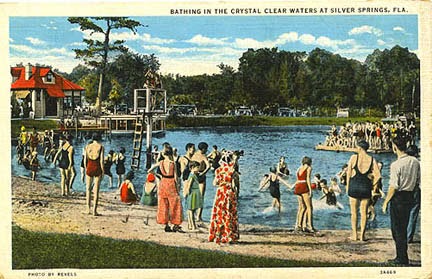
A vintage postal card showing the swimming area.  There's the float packed with swimmers in the right center of the photo.


      A few years ago, I went back to Ocala for a high school reunion.  One activity was a glass-bottom boat ride at Silver Springs.  A boatful of us set out for a trip down memory lane.  To say we were shocked is a huge understatement. The water level was considerably lower. The once white sandy bottom was covered with long green, slimy strands of algae, and the fish were just gone.  An occasional one would swim under our boat, but nothing like the fish schools of our memory.  All that was once free, admission, parking had theme park fees, and swimming in the cooling waters was no longer allowed.  

Development in the area around Silver Springs had allowed nitrates and impurities to seep into the water.  Once there was protective marsh around the springs area, but that had been drained to make way for houses and strip malls. There has been a 90% loss in the number of fish. Then there is the Rodman Dam that  slowed the water flow of the Ocklawaha River fed by Silver Springs and other springs along its 78 mile course.  According to the Florida Defenders of the Environment, the Ocklawaha once made the 60 miles from Moss Bluff to the St. Johns in 3.6 days. This slowed to 23.4 days after the dam was built.  Algae and aquatic weeds could grow unhindered. 

The dam is north of Silver Springs near Palatka.  It was to be part of the Cross Florida Barge Canal whose construction ended in 1968 shortly after the dam was built. Now the Rodman Reservoir is mostly used by fishermen though the number of fish has decreased since the dam was built.  Even though it is called a reservoir, it provides water for no one. It can't be used for swimming because of alligators.  It serves little purpose except to nourish water plant life that chokes the water way.  

  The Ocklawaha River is is an old river with a fascinating history.  It's many crooks and turns have been navigated by Indian canoes, steamships taking tourists from Palatka to Silver Springs and steamships running goods for the Confederacy during the Civil War. 
It's course is mostly in Marion County (Ocala--the county seat).  My dad and I used to take a little motor boat down the river.  Paddling on the river felt like another world.  In those days it was very quiet, dark and lined with palms and exotic plants.  Birds and alligators were abundant.  


(map from Silver Springs)
This map shows the crooked and winding course of the Ocklawaha.
The Rodman Dam is south of Palatka, somewhat in the region called
Devil's Elbow.

    Currently, there is great controversy among environmentalist, fisherman, and county governments over removal of the dam.  The environmentalist say if the dam is removed the 20 springs flooded when it was built and the Ocklawaha can return to their original natural beauty.  Fish will return to Silver Springs and the water level will rise.
Others argue that the dam provides recreation and commerce especially for Putnam County. When Jeb Bush was governor of Florida, he ordered the dam removed, but it was not done, and Governor Scott turned the order around.  So, the debate goes on.

  Florida Department of Environmental Protection (FDEP) (2002a):
"The Rodman Dam acts as a barrier to the dispersal of migratory fish and West Indian manatees that historically used the Ocklawaha River system. Removal of the dam would restore historic connections and restore the fish population of the Silver River."

          The steamboat Hiawatha in the top photo approaches Silver Springs.  The bottom photo shows the Hiawatha steaming down the Ocklawaha.  These postal cards are
dated 1914.  Amazingly the big boats could navigate the narrow water way.  Northern tourists thought they were in an exotic land, calling it "the sweetest water."

(photo purchased on Ebay, no attribution given)
For a while, Silver Springs had a railroad depot.  It was also the steamboat wharf located  about where the glass bottom boats later loaded and unloaded passengers. (about 1914)  


Click on Internet sources to read more about Silver Springs, the Ocklawaha and the Rodman Dam:


There is a series of articles written about the time of the heyday of travel on the Ocklawaha, 1870-1876 in The New Harper's Monthly Magazine.  These are from Cornell University and available online.  They are fun to read and give a true account from the day.  Harper's New Monthly Magazine, "Six Weeks in Florida"


Monday, February 9, 2015

Chocolate and the libido; Is chocolate the food of love?


         An interesting aspect of chocolate history is the lore associated with chocolate as an aphrodisiac or libido enhancer. Stories are still around about Montezuma, the Aztec emperor of 13th century Mexico, who is said to have drunk 50 cups of chocolate every day from a golden goblet. 

       Since Montezuma had a harem of 600 wives, he possibly felt some pressure to enhance his sexual prowess. Women, of course, were not permitted to drink chocolate. Chocolate was considered a royal aphrodiasic and only the gods and rulers were supposed to drink it. 

     Montezuma's chocolate drink was a combination of ground cocoa beans, hot peppers and ground vanilla beans. The European explorers who tried it were not impressed. 
An explanation for the reputation of Montezuma's chocolate is that chilies, curries and other spicy foods have physiological effects--raised heart and blood pressure rates--similar to the physical reactions of sex. Perhaps the hot peppers helped Montezuma believe he was sexually enhanced. Centuries later, Spanish Queen Isabella's cook substituted sugar for the hot peppers. The new sweet drink instantly became the rage. 

Casanova, the famous Italian lover, thought chocolate aided his libido. He preferred drinking chocolate to champagne before going out on his nightly adventures. In his memoirs, he writes of drinking chocolate for breakfast. 

       Chocolate has become associated with Valentine's Day as the favorite gift of love. According to the Chocolate Manufacturer's Association, 35 million heart-shaped boxes of chocolate were sold for Valentine's Day. It was Richard Cadbury, son of the founder of Cadbury Ltd, who created the heart-shaped candy box for Valentine's Day in 1861. 

      Stories of chocolate as an aphrodisiac are interesting, but is there any scientific evidence that chocolate enhances the libido? Much has been written on the subject. Research proposes that the neurotransmitter in falling in love may be phenylethylamine (PEA), which is found in chocolate. It can heighten senses, raise blood pressure and sugar levels and give a feeling of well being. Chocolate also contains substances that stimulate the brain in ways similar to marijuana and coffee. Chocolate contains theobromine, a mild stimulant and phenlethylamine, a euphoric. 
      On the other side of the question, Randy Cornelius in his book The Science of Emotion writes, "The true aphrodisiacs are our beliefs about certain things. If you believe chocolate is a food of love and romance, that belief sparks the romantic flames when it is given as a gift." Perhaps the aphrodisiac properties proclaimed all these years have only been in our heads?


Sunday, February 1, 2015

Valentine Conversation Hearts


If you are a shy sweetheart or a very young one, you can express your love with conversation hearts.  NECCO (New England Confectionary Company) has made the sweethearts since 1866 after Oliver Chase developed a method of stamping candies with messages.  Considering that over 8 billion candy hearts are made per year, Conversation Hearts are the best selling Valentine candy. They come in two sizes, many colors and flavors.


                                Smile, Sweet Thing.  You are my destiny, the one I love
                             for keeps.  Let's kiss.

                                Slow down.  Be good, very good.

                                Why not.  You're so fine.  Let's talk.  Fax me.

Messages on the hearts have kept up with the social media generation, including ones that say, "text me" and "LOL."   The UK equivalent is called Love Hearts manufactured by Swizzels Matlow.  Candies are made with messages for non-English speakers as well.

This Valentine's Day, buy a bag and let your feelings be known.  "It's True"  "You're so fine"

Friday, January 23, 2015

Wild Things in my Backyard

The creatures in my Florida yard are not the scary kind though we did have a resident alligator in an apartment pond a few years ago.  The wild things in my house yard are pretty tame, but they are a great source of amusement and interest.  The main draw for them is a retention pond fed by storm drains.  About 75x40 yards, it attracts an amazing array of wildlife.  When I see something interesting there, I run out with my cell phone to capture a photo.


The pond in January

Birds are most numerous.  We've had geese nest under the trees, osprey diving for fish, and hawks and bittern roosting in the tree branches.

Grumpy looking bittern

Hawk possibly wanting a fish

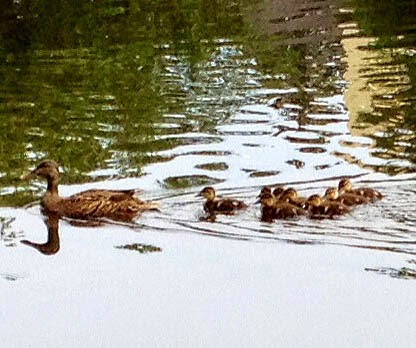
                                                      Mother duck with ducklings

The geese are ever present.   Note the turtle on the bank
observing this gaggle. I've learned that geese are very
good parents.  The Daddy Goose is always present and
protective.  Father Ducks, on the other hand, disappear
and are never around for protection.  The goslings stay
with the parents until they are ready to search for their 
own mates.

Four ibis in the foreground, a great blue heron
in the middle and two wood storks at the back right, 
intently look for fish.

The most exotic bird I've seen in the back yard is a roseate spoonbill.  He is exotic because they usually do not live as far north as Jacksonville Beach. He didn't stay very long the day I saw him and he has never returned. 

Roseate Spoonbill

An otter comes to the pond every few months, more in the summer.  He stays for a while, swims the length of the pond several times, catches a fish or two and goes back into the storm drain opening.  We don't know where he lives.  Our pond is just a little side trip for him.  Once he brought a wife and a baby.

                                      An otter pokes his head over the bank.

                                      Otter sunning on the bank.  This was a photo
                                      op for the neighborhood.

Florida has much wildlife, but habitat is disappearing and so goes the wildlife.  We feel honored that so many wild things still come to our yard.  


Thursday, January 15, 2015

Cheerful Times: An Overview

2014 was the worst of times and the best of times (apologies to Charles Dickens). I often wondered where the world was going considering all the insane murders, terrorist attacks, and just plain cruelty.  It was hard to watch the news, and I am a news hound.  The best of times? Where were they?  Mostly, for me, they were personal and related to happy family events and travel.  I choose to concentrate on them in this overview. 
  
We must all do that, of course, find the stillness within and look to the positive.  This doesn't mean we hide our heads to the sadness.  We must be aware of the world and do what we can to try to get ourselves and others past the horrors.  

Here are a few photos of my 2014, happy moments:

SPRING


A goose pair laid eggs and raised their goslings
                                    in my back yard.  The family was an endless source
                                    of interest to us.

                                                My husband and I took an enjoyable spring
                                            trip to South Miami and South Beach.  I felt
                                            moved to blend in with the sculpture.
SUMMER
                                      My youngest grandchild graduated from high
                                      school.  He's the one in the gown and mortar 
                                      board.  This photo shows parents and both sets
                                      of grandparents there to celebrate.

AUTUMN        
                                     A field of pumpkins in Blowing Rock, NC.  We
                                     traveled there with our daughter and grandkids.

  Dan and I travel to NYC to see the Macy's 
Christmas Parade.  It was very cold to us 
two Floridians.
WINTER

These good friends and I meet every few months
for lunch.  We all taught at the same school and
are retired now.  I've known some of them for 33
years.  This was our Before Christmas luncheon.

                                      My dear daughter and only child earned her PHD.
                                      Here we are at the December graduation.

                                      Here she is with her beautiful family and my 
                                      beautiful grandchildren.  Who couldn't be happy 
                                      on such an eventful, wonderful day.

                                     Another happiness for me, my regal cat Bella. 

I hope you've counted your happy moments in 2014.  We all have them.


Saturday, January 3, 2015

Sweet Pete's in downtown Jacksonville

Elegant and beautiful, Sweet Pete's and the Candy Apple Cafe & Cocktails have moved into the renovated Seminole Men's Social Club to sweeten downtown Jacksonville.  The 22,000 foot space has been painted and decorated far, far differently from its 1903 origins.  At the corner of Hogan and Duval near Hemming Park, it is a destination for school and education groups and sweet-tooths.  A wonderful respite from downtown traffic and noise, it is a different world of color, whimsy and sweetness.


Every room has unusual furnishings and fanciful chandeliers, a big change from the formal, dark, well. . .stuffy men's only club inhabiting it until 1989.  Peter Behringer, son of Phyllis Lockwood, owner and founder of Peterbrooke Chocolatier, a much loved Jacksonville candy store, saw its possibilities as a candy store after it had been deserted for a decade.  


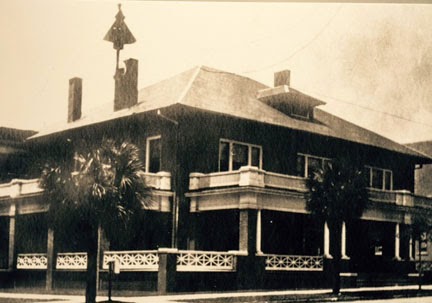
                                                The original Seminole Men's Club.


                                     Now refurbished home of Sweet Pete's and the 
                                     Candy Apple Cafe & Cocktails.


                            A bakery and dessert shop occupies one of the rooms.

Sweet Pete's is more than a sweet shop.  It offers classes to adults and children that teach  the art of creating candies and desserts.  It is also a great venue for a birthday party for any age.  


A plate glass window overlooks candy making activities.  Tours of the candy making facility can be arranged.


                                      In the store at Sweet Pete's visitors can buy
          regular, vegan, sugar-free, and gluten free candies.


                                             The Candy Apple Cafe & Cocktails 

                                       More fanciful chandeliers

Sweet Pete's is a wonderful addition to downtown Jacksonville.  A great day would be to go to the library, then walk next door to the Museum of Contemporary Art (MOCA), and then across Hemming Park to Sweet Pete's.  With more such businesses, downtown will resurrect.  


                                                      Sign at Sweet Pete's